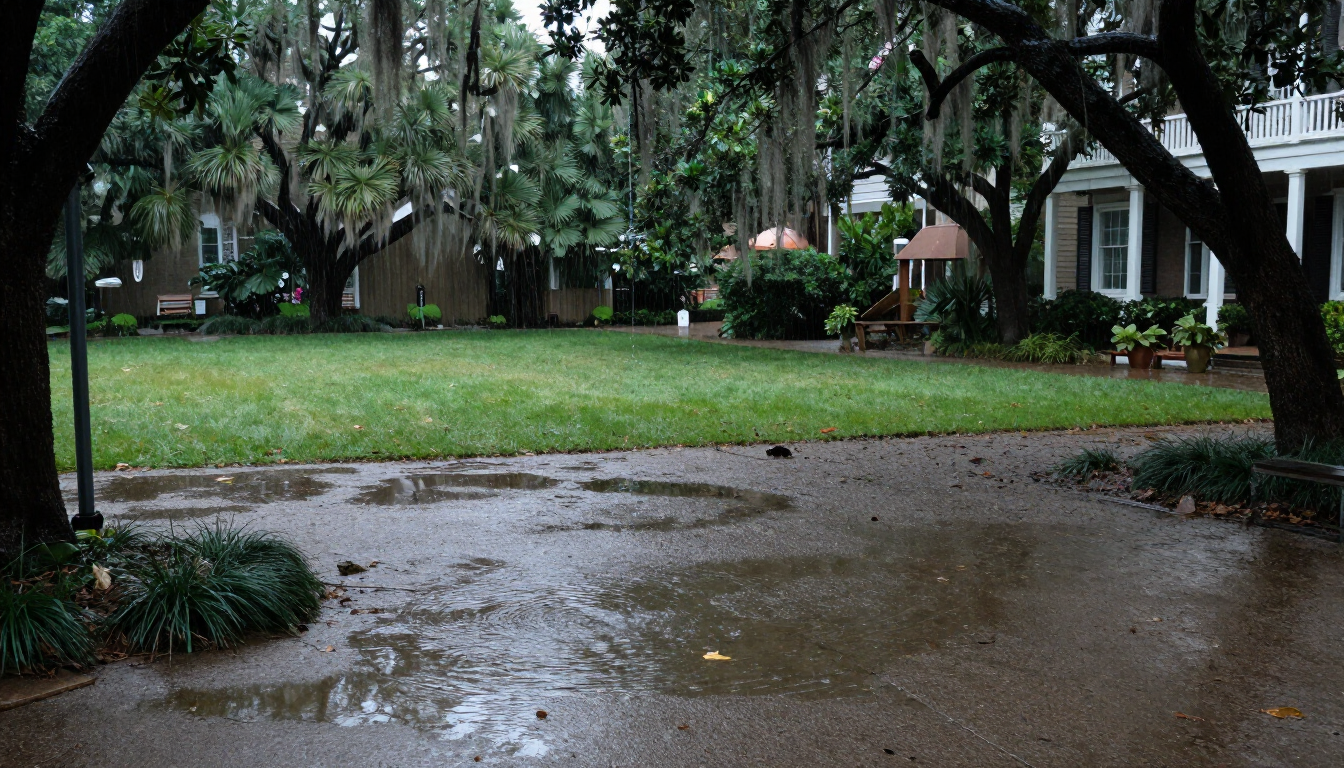
Flat grades, high water tables, and summer downpours turn Lowcountry yards into swamps. Here is how to read the water on your property and give it somewhere to go.
If your Charleston yard turns into a pond every time it rains, you are not alone — and it is not your imagination. The Lowcountry is one of the hardest places in the country to keep a yard dry, for reasons that are baked into the geography. The good news is that almost every yard can be fixed. The first step is understanding why the water is there.
Three reasons Lowcountry yards flood
- Flat grades — water moves slowly across flat coastal lots and has no natural path off the property.
- High water tables — in many areas the groundwater sits close to the surface, so there is nowhere for rain to soak in.
- Heavy summer downpours — Charleston can get inches of rain in an hour, overwhelming any system that was not sized for it.
Add roof water dumping out of downspouts at the foundation, and you have a recipe for a yard you cannot use for days after every storm.
Read how water moves across your property
Before we design a fix, we watch the water. The next time it rains hard, put on a raincoat and walk your yard. Note where water enters the property, where it pools, where it runs, and where it tries to exit. That map tells you everything — where to install collection points, where to run pipe, and where to send the water so it leaves for good.
The goal is never to "stop" water. Water always wins that fight. The goal is to give it a faster, cleaner path off your property than the one it is taking now.
The tools that actually work
A proper drainage system usually combines several of these, sized to your yard and your rainfall:
- French drains — a trench with perforated pipe and clean stone that collects groundwater and carries it away.
- Catch basins — installed at low points where water naturally pools, feeding surface water into underground pipe.
- Channel drains — linear grates set flush with a patio or driveway to catch sheet flow across a hard surface.
- Regrading — filling low spots and re-pitching the yard so water moves toward its exit instead of sitting.
- Downspout tie-ins — connecting roof runoff directly into the underground system so it never hits the ground near your foundation.
Why "just add a French drain" usually fails
A French drain dug too shallow, filled with the wrong stone, or run to nowhere will clog and fail within a season. The pipe needs clean, angular stone wrapped in filter fabric so silt does not fill the voids. It needs a positive exit — a daylight outlet, a dry well, or a connection to stormwater. And it needs to be deep enough to actually intercept the water table, not just the surface.
Done right, a drainage system is invisible once installed and gives you back a yard you can use the morning after a rain. If standing water is ruining your Lowcountry yard, we will read the water with you on a free site visit and send an itemized plan to fix it.